Sometimes, people just need to be told what to do and how to do it. Such was the case recently with one of my clients after an employee of his was caught by a coworker drinking beer on the job site. Clearly, it was a violation of the company’s policy and grounds for immediate termination. Taking specific and immediate action was warranted, and handling such action in accordance with the proper procedures was necessary.
With these types of issues, leaders can choose to empower the immediate supervisor to handle things appropriately and expect (or hope for) the best possible outcome. Or they can step in and micromanage the situation by giving specific instructions or even performing the necessary action themselves, which is what ended up happening in this scenario.
The quandary often faced by management and leadership is knowing when to micromanage and when to macromanage. There needs to be a balance between telling employees what to do and how to do it while giving them the autonomy to do their jobs effectively.
What is Micromanagement?
One of the best definitions of micromanagement that I’ve seen comes from the folks at Gartner, who state: “Micromanagement is a pattern of manager behavior marked by excessive supervision and control of employees’ work and processes, as well as limited delegation of tasks and decisions to staff.”
When most think of micromanagement, the emphasis is on the excessive supervision and control part. This is generally obvious in most management behaviors as “thinking” for your staff. This limits the decision-making ability of employees, minimizes creativity, and relegates their accountability to specific instructions they were given by their supervisor. Consequently, this also limits the organization to the boss’s thinking capacity, not the staff’s working capacity.
While micromanagement is largely understood in most business arenas, the real reason I like Gartner’s definition so much is their recognition of limited delegation. I’ve always believed that if people really understood what micromanagement is, they would love working for micromanagers because their boss would basically do their job for them. This scenario frequently plays out with restoration contractors when a project goes sideways, and the manager steps in to reach a resolution. Effective? Maybe, but in the long run, there are dozens of reasons why it isn’t sustainable—many of which lead to an overall lack of empowerment and cohesiveness among the team. My wife calls this “Minion Mentality.”
What is Macromanagement?
I like to think of macromanagement as the devil on the other shoulder, or micromanagement’s polar opposite. Scholars and other management experts will most likely disagree, and that’s fine. But if we consider macromanagement as the boundary on the other end of the spectrum and look at it from that perspective, we can identify an effective balance between the two, given the criteria of individual situations.
Macromanagement can then be defined as excessive autonomy with employees’ work and processes as well as complete delegation of tasks and decisions to the staff. This is also known as laissez-faire management, where leaders are hands-off and give others complete freedom to make decisions at will, accepting the eventual outcomes as they are. But with too much latitude and limited supervision, quality and performance become unreliable. Teams have little to no alignment with goals and zero accountability.
Macromanagement often winds up becoming the default style of sales and marketing units, especially when the manager has little or no knowledge of the activities or expected results of their staff. In these cases, the employees are given business cards, an expense account, a pat on the back, and told to “Go make it rain!”
Micromanagement or Macromanagement
If the spectrum of management was truly a range with micro at one end and macro at the other, then common sense would say to just strike a balance between the two and everything will be fine. As a logical individual, I would tend to agree. However, it would only be effective a fraction of the time because every employee is different, and almost every situation is unique. The common thread that runs through all of this is the desired outcome, with risk being the fine line between success or failure.
I believe that the most effective managers understand this and seek to employ management strategies at different points along the spectrum situationally, based on a risk analysis of the circumstances. If the risk of failure is high, they slide toward micromanagement. If the risk of failure is low, then macromanagement it is! Anything in the middle is fair game for a combination of guidance and autonomy, with a healthy dose of delegation and supervision.
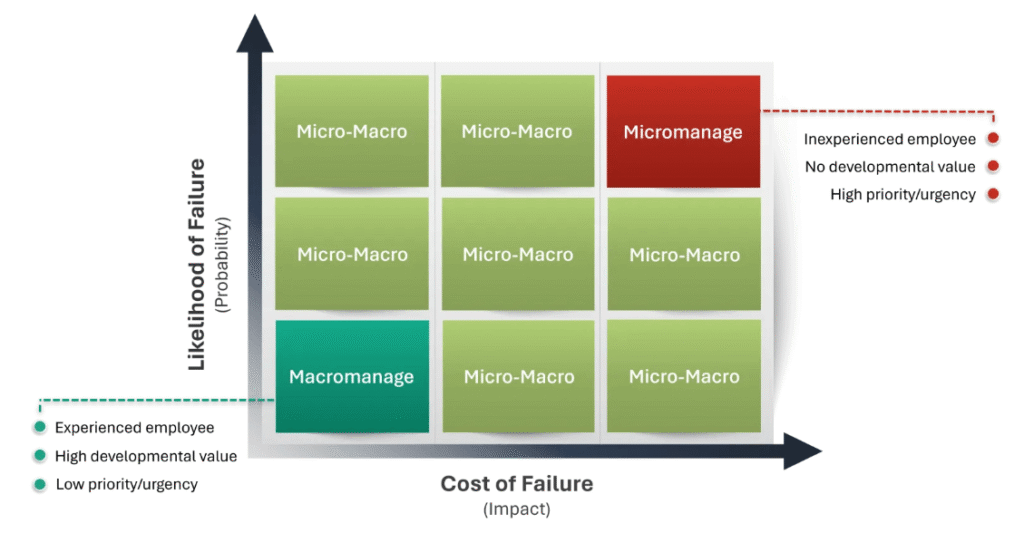
For those who are more process-driven, think of it like this:
- Define the situation and the desired outcome.
- Determine the tenure and experience of the employee(s) involved.
- Identify the priority and urgency of the situation. (Is it an emergency or crisis?)
- Calculate the training and development value of the situation for the employee(s).
Once these four steps have been completed, consider the likelihood (probability) of the employee failing and the cost (impact) of that failure. As you can see, the criteria associated with each of the four steps above had an influence on probability and impact. The degree of influence can then be impacted by the level of micromanagement or macromanagement strategies deployed, making style flexibility a key component in the equation.
Regardless of the scenario, managers need to remember that creating a balance between micromanagement and macromanagement must be accompanied by a host of best practices in management. Set clear expectations for employees, including goals, results, and deadlines. Provide the appropriate resources and support for them to be successful. Communicate clearly and effectively. Encourage creativity and provide timely feedback on performance and decision making.
By using this combination micro/macromanagement philosophy, being flexible, and striking a balance between providing guidance and autonomy, employees can be both managed and empowered to perform at levels that consistently meet or exceed company goals while maintaining a healthy and engaging culture.
Published in C&R Magazine