Early in my restoration career, I didn’t lack drive, intelligence, or work ethic. I lacked people. My professional world ended at the logo on my shirt, and that logo was shared by just six others within Violand Management at that time. No outside peers. No external perspectives. No one beyond the said four walls of our company that I could lean on to challenge my thinking or confirm I wasn’t about to make an expensive mistake. Every decision, doubt, and hard lesson stayed trapped inside that small circle.
Whether I realized it or not, that isolation made the climb harder, slower, and far more expensive.
My first industry event where I could meet others was Connections (now called The Experience) at the Las Vegas Hilton (now called Westgate Las Vegas Resort & Casino) in September of 2012.
It’s where I played my first game of chance in a casino. I started with $20. I still have the cashout ticket hanging in my office showing I left with $9.75, ensuring I wouldn’t go Kenny Rogers and ride a train bound to nowhere as a professional gambler.
At that show I made my first real attempt at building industry connections (see what I did there?) and struck up several great conversations with a man who was the owner of a vendor company that promoted using heat instead of chemicals for various restoration means. I thought I had something going, until I was told the company had lawsuits against several of our current and former clients as well as others and was probably not the best place to hang my hat at that time.
Busted. Live and learn, I guess.
My real mistake had nothing to do with whom I was trying to capitalize from to start building my network; it was what I was trying to get from him. I looked at this industry vet as a potential customer or lead source I could ride the coattails of. Instead, what I needed was a group of peers I could learn with and experience (see what I did there?) the industry together. People like me, but hungrier and smarter in their own ways.
Soon after, the Restoration Industry Association (RIA) formed the Young Restorers initiative, bringing together the next generation of professionals under the age of 35 to bind together through a new network of peers. I jumped at the chance. What I didn’t expect, but needed most, was that RIA leadership didn’t stick a crusty ole veteran in front of us to lecture. Instead, they gave the group real responsibility and said: figure it out your way, not ours. They treated us as competent. Or maybe they just didn’t want to allocate resources to our group … but either way, it instantly built needed confidence amongst ourselves. We had two things going for us: an opportunity to learn and each other for support. Our primary assignment was to give a presentation at the next RIA Convention.
And that’s how it started.
A group of nobodies got together and began a process to become somebodies.
The group at that time included:
• Myself, sales representative at Violand Management
• Matt Hensley, sales director at Total Restoration
• Michelle Blevins, editor-in-chief of R&R Magazine
• Christopher Yanker, production manager at Buffalo Restoration
• Jocelyn Dornfeld, office and marketing manager at A&J Specialty Services
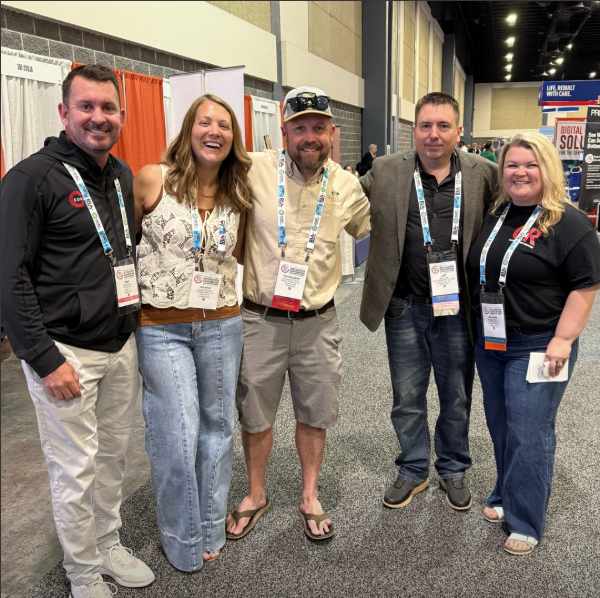
Suffice it to say, our inexperience was obvious, but fortunately for us, we didn’t know enough to be intimidated. So we met, we worked, we learned, and we leaned on each other. Similar to games of chance in Vegas, we pushed our chips to the middle, went all in, and like the gambler we broke even. The result was an adequate and decently attended breakout session at the conference. The topic was digital marketing, and Jocelyn had to spend a significant amount of time answering questions as to what hashtags were and how to use them (the audience continued to call them number signs and had no clue the significance). It took a younger group to be on stage and educate the ole crusty veterans about changes that were coming. The industry needed new voices. RIA allowed ours to be formed and heard. We did our job. But then something else happened.
We stayed in touch. We kept meeting—mostly informally but always intentionally. Over time, we kept asking questions and comparing notes. The Young Restorers lived to fight another day. We relied on one another, and when one of us learned something valuable, it was shared with the group. Collective victories resulted in individual wins. Over time, we built something more than a network. We built a bond that still exists today, a decade later. And through it all, each of us accomplished more than we ever could have done alone.
But Father Time is a merciless dealer and brought forth a stacked deck we couldn’t overcome via group innovation, new technology, or naive gumption: we turned 36 years old and aged out of RIA’s Young Restorers Network, and nobody stepped up to take our place. Did we fail at passing the torch to ensure the initiative lived on? Did new RIA leadership no longer support the initiative? Was there no one interested in stepping up? I’m not sure, but it was probably a combination of all three. And with that, the formal initiative died.
But our group never stopped having conversations and in doing so, we kept our growth alive.
I grew into a director role at Violand and now have a team reporting to me that I love while also coaching salespeople and chairing two RIA committees. Matt grew into a leadership position with Kustom Restoration and is now president of the CORE Group and serves on the RIA Membership Committee. Michelle started her own company, purchased C&R Magazine, and is a leading voice in restoration while serving on multiple RIA committees. Christopher is now the general manager at Buffalo Restoration, a co-chair for Leadership Bozeman, and one of those extremely well-respected industry veterans people look up to and ask for advice. Jocelyn has gone on to start three companies, including Three65 Marketing and Profitable Restorer, and continues to serve the industry she loves.
To this day, whenever I get a chance to talk in person or over the phone with any of them, I can feel in my heart the bond that’s still there. We grew up together. We genuinely care for each other. Being part of our peer group was bigger than any one of us. That group of people is a solid manifestation of anything I did right in my career.
At this point, I am going to encourage two different collectives of people.
The first is you, the reader. Notice that when our peer group first got together, none of us were owners or had any real professional identity. We were all just hungry to belong. So where are you with your career? Do you have a group of peers you can fully trust and rely on for guidance and support? Have you built your team, your tribe, your circle—people from outside your own company that you want to learn with?
Why Peer Groups Matter in the Restoration Industry
Here’s why it matters: peer groups create the kind of trust, learning, and resilience that formal systems often can’t.
- Psychological safety and trust – Organic peer groups create higher levels of trust. Members feel safer sharing doubts, failures, and unpolished ideas more so than they will in a hierarchical setting.
- Faster learning through shared experiences – Peers are often dealing with similar challenges, so advice and discussions are practical and immediate. They are customized and personal. They come from lessons learned in real time, not implied theory.
- Accountability without bureaucracy – Informal accountability can often be more powerful. Commitments made to peers are deeper rather than being procedural, often motivating follow-through because it’s the right thing to do versus formal performance structures.
- Emotional support and stress reduction – Having peers to lean on serves as a pressure release valve. Knowing that others you care about are facing similar struggles reduces isolation, normalizes setbacks, and improves resiliency.
- Cross-pollination of ideas – My peers are each better than I am at many things. Their openness encourages creativity and expands my thinking.
Build your group. And be intentional about it. This isn’t a BNI thing where we are all trying to get business from each other. It’s stronger because it’s real. It’s a small group of people you trust from the industry who simply want to be better.
Here are some tips on forming a group.
Use existing industry gatherings as launch points – Attend industry events and be resourceful. Don’t spend your time trying to hunt down the president of RIA, thinking you have indistinguishable desires. Most likely, you are dealing with completely different challenges. Find people in a similar career stage as you, so you can grow together.
Keep the group small. You will thank me later. A few very close friends will always provide more merit than a large group of associates.
Keep the initial commitment light. There is no reason for long agendas or weekly meetings. You are looking for people to rely on who need you as well, all at their own speed. Trust is built through conversations, not presentations.
Confidentiality is your core value. I will tell you I have a group, but I will never share the individual conversations that lead to the laughter, tears, and progress. If I confide in Matt or any of the others, I know it stays with him and vice versa.
My peer group was initially formed by an industry association, but we stayed together long after because it was meaningful and important to each of us. It was the years that followed that really made the difference. Purpose-driven, informal, professional peer groups aren’t built through strategy or formalized invitations. They are built through trust, shared experiences, and consistency. The less they feel like an obligation, the more powerful they tend to become.
Strong peer groups in the restoration industry help professionals grow faster, share knowledge, and build lasting trust across the field.
The other collectives I want to address are the industry groups, specifically RIA and the various Facebook and LinkedIn factions. The Young Restorers Network was one of the most powerful and impactful influences on my career. What can you do to recreate it? A new generation of professionals is hungry to belong, to listen, and to be heard. Create space and cultivate freedom to make it happen. They need you. But just as importantly, you need them. #ARisingTideRaisesAllShips. Jocelyn taught me that. Strong peer groups in the restoration industry help professionals grow faster, share knowledge, and build lasting trust across the industry.
Published in C&R Magazine