The Hidden Ceiling in Small Business, Part I
A lot of owners don’t realize they’re leading up to a ceiling they can’t yet see.
In large corporations, leadership gaps are frequently absorbed by layers of management, institutional systems, or sheer scale. In small businesses, the owner typically sets the culture, pace, strategic vision, and emotional thermostat of the company.
The owner’s thinking becomes the company’s thinking. Their discipline becomes the company’s discipline. Their emotional maturity sets the ceiling for the team. While this might feel comfortable, eventually it will affect the company’s ability to grow.
Every company runs into a moment where technical skills are no longer enough to continue its progression and it must rely on the owner’s ability to lead the organization.
In small businesses, there is an invisible ceiling that eventually limits growth. Most owners assume that ceiling is the economy, labor shortages, competition, or market conditions. More often than not, it’s actually the leader. A business rarely outgrows the personal growth of its owner.
In the early years, companies are often built through sheer force of will. Long hours, technical expertise, hustle, and sacrifice carry the business forward. Owners solve problems personally and outwork their competitors. For a while, that works, until growth changes the rules. Then it’s no longer about doing today, it’s about leading. Strategic thinking, communication, delegation, and the ability to develop others are required. This is where many businesses stall.
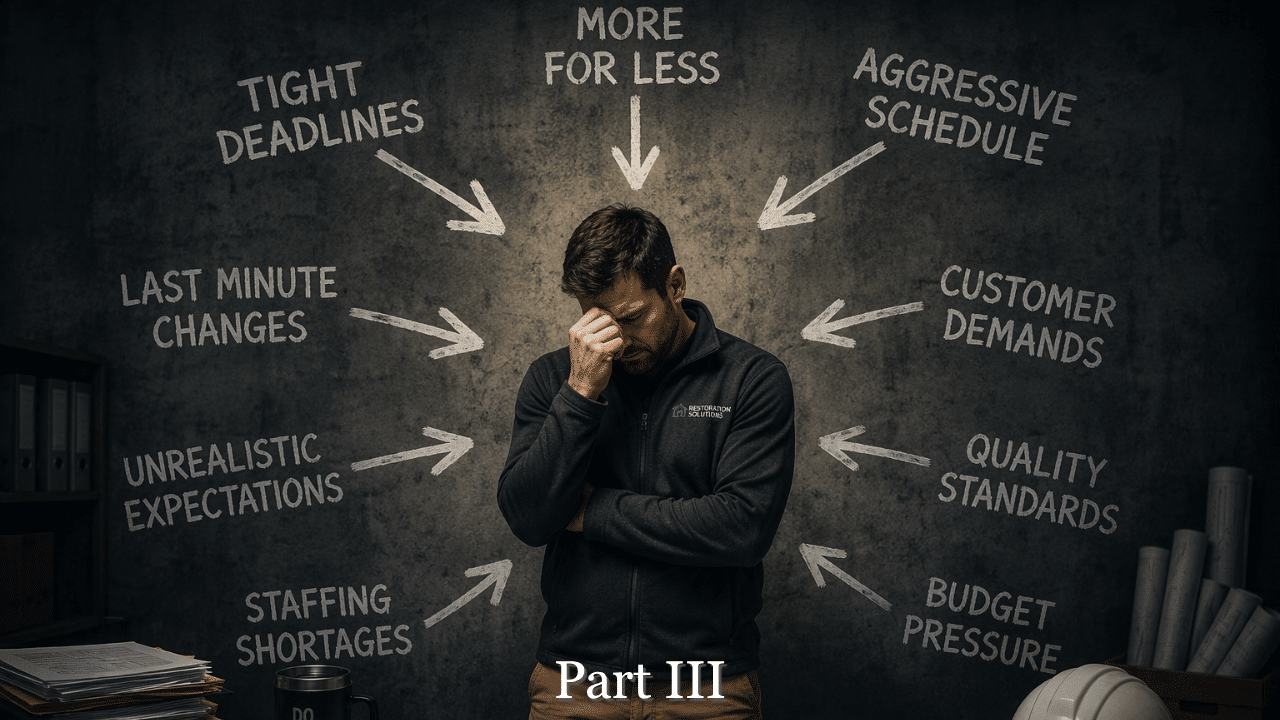
The owner who once did everything is now the bottleneck. Decisions pile up. Managers hesitate. Employees become dependent instead of empowered. The company appears busy but, in reality, growth plateaus. And most don’t even realize it’s happening.
The problem is not effort. Most owners continue working incredibly hard, but hard work alone won’t compensate for leadership inertia.
When leaders continue growing, companies expand in capability along with them. Communication improves. Teams become stronger. Accountability deepens. Better leaders emerge within the organization. The company gains resilience.
But when leaders stop developing themselves, the effects eventually spread everywhere. Culture weakens. Innovation slows. Turnover rises. Decision making deteriorates. Employees stop growing as the environment around them stalls.
What makes this dangerous is how gradually it happens. Decline rarely announces itself dramatically, and most businesses don’t collapse overnight. They drift into mediocrity, believing they are simply “maintaining.”
In leadership, standing still is rarely neutral. Markets evolve. Employees evolve. Customers evolve. Competitors improve. An owner who stops learning is eventually leading with outdated information. This is the equivalent of standing back and admiring their own trophy case. Eventually, the rest of the world passes them by.
The question for business owners is: are they still growing or just remembering when they did?
Author

Stay Updated
Subscribe to our newsletter